
Start here: what to do
Tendon and fascia change slowly. Here is how to train the slow stuff.
- Load it, do not just stretch it. Connective tissue gets stronger when you load it again and again over months. Long passive stretching does far less. Stretching gains also plateau near 10 minutes a week per muscle, so extra stretching time buys little.
- Do slow, heavy work for tolerance. Use a controlled tempo and a real load. Think slow calf raises, slow squats, slow rows. This teaches tendon and fascia to handle big force without complaint.
- Add bouncy work for spring. Hops, skips and rebounds teach the tissue to store and give back energy. That is what sprinting and jumping run on. Bring it in gradually, after the slow work feels easy.
- Move in more directions. Sit all day or train in straight lines, and some ranges just go unused. Unused ranges feel tight. Add turning, reaching and side to side work most days.
- Use the roller for how you feel, not for change. You cannot roll fascia into a new shape. Rolling mostly changes how the area feels for a while. That is still useful before a session. The change in what you are made of comes from loading.
- Go slower than your muscles want. Muscle gets strong in weeks. Tendon and fascia take months. Add load in small steps so the slower tissue keeps up.
Expect months, not weeks. You will feel stronger long before your tendons are ready for that strength. That gap is where a lot of injuries live. Judge progress by whether hard days still feel fine 2 days later, not by how fast your lifts climb.
Safety. This is general coaching information, not medical advice. Tendon pain that lasts, swelling, a joint that gives way, numbness or weakness, or recent surgery all need a qualified clinician. Rehab and return to sport are their call, not a training plan's.
The short version
For decades, sports science treated muscles like separate machines: each one bolted to bone by its own tendon, doing its own job, minding its own business. That picture is wrong, or at least badly incomplete. Muscles are wrapped in and connected by a continuous web of tissue, and that web moves force around in ways a diagram of individual muscles cannot explain.
This article is about that web, usually called fascia. What it is made of, what it does, why a tight calf can change how a hamstring feels, and what actually improves it. Some of the popular claims about fascia are overblown, so the goal here is the useful part without the mysticism.
The web under your skin
A therapist spends the whole session working on your hip. Your sore knee gets better anyway.
That’s not magic, and it’s not a scam. It’s fascia — and once you know it’s there, a lot of the weird things your body does start making sense.
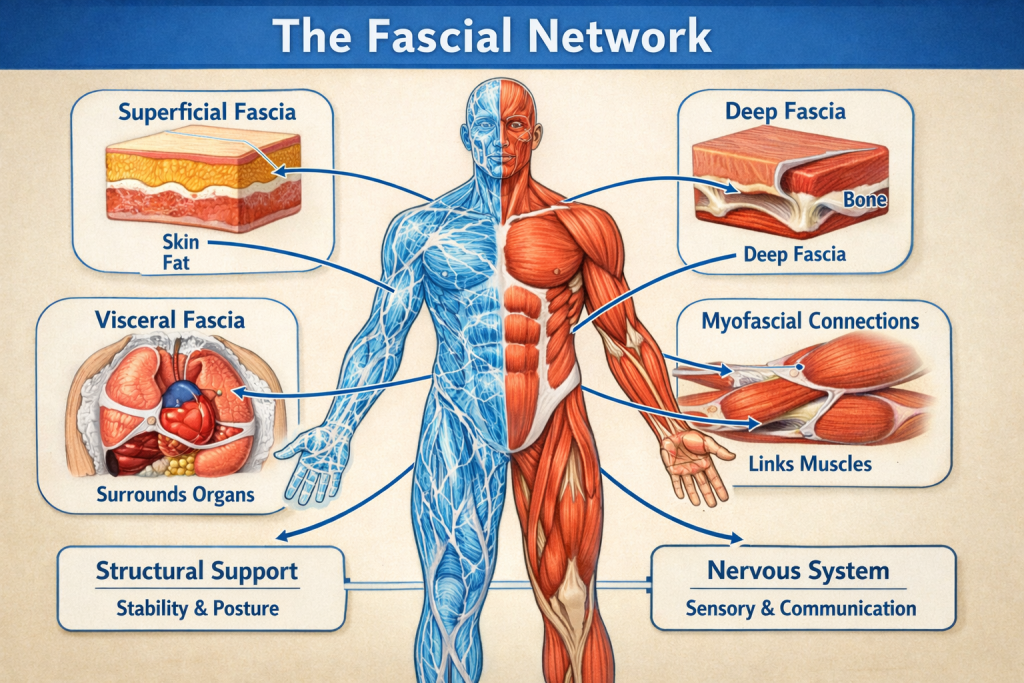
Fascia is a continuous web of connective tissue that wraps every muscle, bone, nerve and organ you own. It never stops — there’s no gap where one bit ends and the next begins.
It can’t contract the way muscle does. It has three jobs instead: it passes force from one place to another, it holds your structures where they belong, and it lets tissues slide over each other cleanly when you move.
One-line recap: you’re not a bag of separate muscles. You’re one connected system.
Think of a tent
Picture a tent. The poles push and pull — those are your muscles.
But the tent’s shape, and how much load it takes before it collapses, depends just as much on the fabric and the guy-lines holding everything in tension. Fascia is the fabric and the guy-lines.
Now tighten one guy-line. The whole tent changes shape, including corners nowhere near the line you touched.
Your body does the same thing. The deep-dive below calls this tensegrity, and it’s why no joint in you ever works completely alone.
Why pain turns up at the wrong address
The old textbook picture said force travels in series: muscle pulls tendon, tendon pulls bone, end of story. Research has shown it also leaks sideways, through the fascial web, into neighbouring muscles — even into a different part of the body entirely (Huijing, 2009).
Which explains some odd everyday findings. A stiff calf can change how your hamstring loads (Wilke et al., 2016). A restricted mid-back can leave your lower back doing rotation it was never built for.
So when a therapist treats your sore knee by working on your hip or your foot, they’re following the web, not guessing. The reasoning is usually sound.
Gym translation: when something keeps nagging, don’t only interrogate the sore spot. Check the whole line — the bit that hurts is often the victim, not the culprit.
Emerging research shows that there is more to what outdated fitness textbooks shows.
The tissue everyone forgets to train
Muscle is the eager one. Ask it for strength and it answers in weeks.
Tendons, ligaments and fascia answer slowly — over months rather than weeks (Kjaer, 2004). Connective tissue changes on a calendar, not a stopwatch.
That mismatch causes a lot of injuries, and the story is nearly always the same. You get strong quickly, you start producing more force than your connective tissue has adapted to, and the tissue is the part that gives.
The muscle was ready. The scaffolding was not.
Under the surface, cells in the tissue sense the load you apply and slowly rebuild the collagen along the lines you stress. Give them steady, progressive work and they upgrade you — they just refuse to be rushed.
Your slowest tissue sets the speed limit, so build load patiently.
Load it, don’t just stretch it
Here’s where gym folklore goes wrong. Long passive stretching does something, but it’s not the main tool.
Connective tissue gets stronger and springier when you load it repeatedly and progressively — including through longer ranges, and with some speed involved.
Two types of loading matter:
- Slow and heavy builds tolerance. Controlled, heavy resistance work teaches tendon and fascia to handle serious force without complaint.
- Bouncy builds spring. Hopping, bouncing and rebounding work teach the tissue to store and return elastic energy, which is exactly what sprinting and jumping run on.
Notice what isn’t on that list: a foam roller.
Worked example: want a more resilient calf and Achilles? Slow, heavy calf work builds the tolerance, and gradually introduced hops and skips build the spring. Same tissue, two different conversations with it.
What the roller can and can’t do
Time for some honesty about the recovery aisle. You cannot foam-roll fascia into a new shape, and you cannot melt adhesions with a lacrosse ball in ninety seconds.
What rolling and soft-tissue work reliably do is change how the area feels for a while. That effect is mostly nervous system, not structure — and it’s still genuinely useful before a session.
So treat rolling as a way to move better today, not as remodelling. The remodelling comes from loading.
One-line recap: the roller changes how you feel. The loading changes what you’re made of.
A lot of “tight” is just habit
Some of what you call tightness isn’t damaged tissue at all. It’s an unused setting.
Sit in one shape for nine hours a day, or train only in straight lines, and your whole system learns that some directions are unnecessary. Nothing is damaged — the range is simply unused, and unused ranges get uncomfortable.
The fix is boring and brilliant: move through more of your available positions, more often. Sprinkle in rotation and variety instead of living on one plane.
That habit tends to do more than any single technique, gadget or ninety-second ritual.
Age isn’t the excuse you think it is
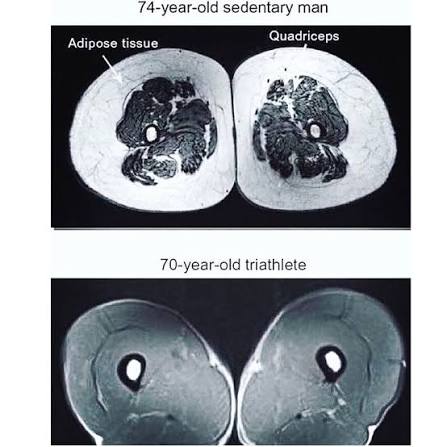
Yes, connective tissue gets stiffer and less elastic over the years. But far less than the stereotype suggests.
Most of the decline people blame on age is really decades of not utilizing tissue. Older athletes who keep loading through full ranges hold onto far more spring than their birthdays predict.
The tissue responds to what you ask of it at basically any age. It just answers more slowly than it used to.
Where the article goes next
The rest gets structural: what fascia is made of, tensegrity and why it’s a useful model for the body, how connective tissue adapts to load, and where the evidence for common treatments actually stands.
Those sections are more technical, so read them when you want the detail. You’ve already got everything you need to train your web smarter this week.
Advanced Section: The Science of Connective Tissue
What Fascia Actually Is, Structurally
Fascia is primarily made of collagen and elastin fibers embedded in a ground substance (a gel-like matrix), organized into sheets and lines of varying density (Schleip et al., 2012). It is broadly categorized into superficial fascia (just under the skin), deep fascia (surrounding muscles, sometimes called the "myofascia" when discussing its close relationship to a specific muscle), and visceral fascia (surrounding internal organs). Anatomists have described continuous lines of fascial connection running through the body — popularized in the "Anatomy Trains" model by Thomas Myers — that link muscles that are not directly connected by bone or tendon into functional chains (Myers, 2020).
Tensegrity: A Structural Framework for the Body
Tensegrity (tension + integrity) describes a structural principle where a system maintains its shape through a continuous balance of tension and compression elements, rather than relying on rigid joints alone — similar to a geodesic dome, where every strut and cable shares load with the whole structure. Applied to the body, tensegrity suggests that fascia, under constant baseline tension, helps distribute load across the entire myofascial system rather than concentrating stress at single joints, and that stiffness or restriction in one area can alter tension patterns throughout the whole "structure."
Myofascial Force Transmission
Traditional biomechanics assumed force generated by a muscle traveled only "in series," through its own tendons to the bones it attaches to. Research over the past few decades has demonstrated significant myofascial force transmission — force transmitted "in parallel," sideways through fascial connections to neighboring muscles and even to muscles in an entirely different segment of the body (Huijing, 2009). This helps explain phenomena such as force changes in the hamstrings when the calf is stretched, even without any direct anatomical joint connection between the two (Wilke et al., 2016).
Mechanotransduction and Collagen Remodeling
Mechanotransduction is the process by which cells (in this case, fibroblasts — the cells responsible for producing collagen) sense mechanical loading and convert it into biochemical signals that drive tissue remodeling. Under appropriate loading, fibroblasts increase collagen synthesis and reorganize collagen fiber alignment along the lines of applied stress, gradually increasing the tissue's ability to tolerate that specific type of load (Kjaer, 2004).
This remodeling process is considerably slower than muscular adaptation — tendon and fascial collagen turnover is often measured in many months rather than weeks, which is a key reason tendon and connective tissue injuries take so much longer to fully rehabilitate than muscle strains, and why progressive, patient loading (rather than aggressive early loading) is critical for connective tissue health (Kjaer, 2004).
Tendon Stiffness
Tendon stiffness refers to how much a tendon deforms (lengthens) under a given force. A stiffer tendon transmits force more directly and quickly from muscle to bone, which benefits activities requiring rapid force transfer (sprinting, jumping), while a slightly more compliant tendon can store and return elastic energy advantageously in certain rhythmic movements (such as distance running). Tendon stiffness is trainable — heavy, slow resistance training and plyometric training are both shown to increase tendon stiffness over time, a key mechanism behind improved rate of force development discussed in the plyometrics section of this series (Zügel et al., 2018).
Practical Section: What "Fascia Training" Actually Involves
- Foam rolling and self-myofascial release: Current research suggests these techniques are unlikely to structurally "release" or permanently lengthen fascia through mechanical force alone; the more likely mechanism is neurological — reduced perceived tightness and pain via effects on the nervous system's tone regulation, alongside short-term increases in local blood flow (Zügel et al., 2018).
- Elastic/rebound training: Exercises that use a rapid stretch-then-release action (such as many plyometric drills, covered in the Section 3 plyometrics articles) train fascia and tendon to store and return elastic energy more efficiently.
- Slow, heavy loading: Tempo-controlled resistance training under significant load is one of the most well-supported methods for improving tendon and connective tissue stiffness and resilience over time.
- Progressive loading for rehabilitation: Because collagen remodeling is slow, connective tissue injuries (tendinopathy, fascial strains) require patient, progressively increasing loading protocols rather than rapid returns to full intensity.
- Full-body, multi-planar movement: Given the fascial lines connecting the body across large distances, training that includes rotational and multi-joint movement (not just isolated single-joint exercises) may better address fascial-level adaptation.
Sport Applications
- Mixed Martial Arts (MMA)/Brazilian jiu-jitsu (BJJ)/Wrestling: Grip and forearm fascia tolerance is heavily taxed by sustained gripping; rotational fascial lines are heavily involved in scrambles and off-balance force production.
- Sprinting/Football: Hamstring and Achilles tendon stiffness are directly tied to sprint performance and are also common sites of connective tissue injury, making progressive tendon loading a key injury-prevention strategy.
- Throwing sports (baseball, tennis, javelin): The shoulder and elbow's connective tissue tolerance is often the true performance and durability limiter, more so than muscular strength alone, given the extremely high repetitive forces involved.
- Dance/gymnastics: Demand exceptional fascial and tendon extensibility combined with control, requiring a careful balance between mobility training and connective tissue loading capacity.
Common Mistakes
- Assuming foam rolling "breaks up" or permanently changes fascia structurally after a single session.
- Rushing connective tissue rehabilitation on a timeline suited to muscle recovery rather than the much slower collagen remodeling timeline.
- Training only in straight-line, single-plane patterns and neglecting the rotational and multi-planar loading that fascial lines are built to handle.
Coaching Cues
- "Fascia doesn't work alone — check the whole line, not just the sore spot."
- "Connective tissue changes on a calendar, not a stopwatch — be patient with loading."
- "Slow and heavy builds stiffness; fast and elastic builds spring."
FAQs
Does foam rolling actually break up scar tissue or adhesions?
There is little evidence that foam rolling applies enough force to mechanically alter dense connective tissue structure. Its benefits are more likely explained by short-term neurological and perceptual effects on tone and pain.
Can you make fascia more flexible permanently?
Fascia does adapt to consistent loading and stretching over time, but changes happen gradually over months, in line with collagen remodeling timelines, not within a single stretching session.
Is "tensegrity" just a metaphor, or is it a real structural property of the body?
It is used both ways in the literature — as a genuinely useful structural/mechanical model supported by some biomechanical research, and as a broader conceptual metaphor. Its precise, quantitative applicability to the whole body is still an area of ongoing scientific discussion.
Recommended Videos
The Role of Fascia in Force Transmission — Rude Rock Human Performance
Watch on YouTube
A focused breakdown of myofascial force transmission — directly expanding on the "force transmitted in parallel" concept explained above.
Why Your Tendons Are Weak: The Science of Building Tendon Strength — The Movement System. Explains why tendon adapts more slowly than muscle, the main reason jumping volume needs patience.
References
Huijing, P. A. (2009). Epimuscular myofascial force transmission: A historical review and implications for new research. Journal of Biomechanics, 42(1), 9-21.
The Basic Science of Tendons & Tendinitis — Sportology. Background on tendon structure and how it responds to load, useful context for this article.
Kjaer, M. (2004). Role of extracellular matrix in adaptation of tendon and skeletal muscle to mechanical loading. Physiological Reviews, 84(2), 649-698.
Myers, T. W. (2020). Anatomy trains: Myofascial meridians for manual and movement therapists (4th ed.). Elsevier.
Schleip, R., Findley, T. W., Chaitow, L., & Huijing, P. A. (Eds.). (2012). Fascia: The tensional network of the human body. Churchill Livingstone.
Wilke, J., Krause, F., Vogt, L., & Banzer, W. (2016). What is evidence-based about myofascial chains: A systematic review. Archives of Physical Medicine and Rehabilitation, 97(3), 454-461.
Zügel, M., Maganaris, C. N., Wilke, J., et al. (2018). Fascial tissue research in sports medicine: From molecules to tissue adaptation, injury and diagnostics. British Journal of Sports Medicine, 52(23), 1497.
Medical disclaimer. FitXplor publishes general performance and health education, not individualised medical advice. Nothing here diagnoses, treats or replaces assessment by a qualified clinician. Stop and seek assessment if you have pain that does not settle, swelling, instability, numbness or weakness, a recent injury, surgery or concussion, or if you are pregnant, under 18, or managing a medical condition or medication. Supplement, rehabilitation and mental-health guidance in particular should be reviewed with a qualified professional before you act on it.
.png)