

Start here: what to do
Your nerves decide how much of your muscle you actually use. Here is how to train that.
- Lift heavy, or lift light with real intent. Sets above about 85% of your best single reach your biggest, strongest motor units. So do lighter sets taken close to failure. Heavy is the fastest route, not the only one. Push every rep like it is heavy, even when it is not.
- Rest 2 to 5 minutes on quality work. This is for max strength and power sets. Short rest makes the next set slower. A slower set trains something else.
- Spread your hardest days out. Do not stack max lifting, top speed sprinting and hard jumping back to back. After a very hard session, it can take up to 72 hours to feel normal again. Give the big days room.
- Track readiness, not just soreness. Log a jump, a grip test or bar speed on the first set. Compare it to your own normal, not to anyone else. A drop while your muscles feel fine is a flag to check. It is a rough signal, not a brain test.
- Rehearse the exact thing you want. Your system learns this move, at this speed, in this position. Slow practice teaches slow. If you want it fast in a game, train it fast in the gym.
- Add a little balance work. Single leg drills and quick balance reps sharpen the sensing side. 5 minutes a session is enough.
Skip the brake story. You will hear that heavy training switches off a protective tendon brake. There is no good human evidence for that. Say you got better at driving the muscle instead.
Expect the mirror to lag. Your lifts can jump in a month while your size does not budge. New muscle usually takes 6 to 8 weeks or more to show. Nothing is broken. Judge the first block by the bar, not the mirror.
Safety. This is general coaching information, not medical advice. If you have pain, swelling, numbness, weakness, or a recent injury or surgery, get checked by a qualified clinician before you start.
The short version
Muscle gets all the credit. It should not. A muscle cannot decide anything on its own. It sits there waiting to be told what to do, and everything about how hard it pulls, how fast, and how well it coordinates with everything around it comes from the nervous system.
This article is about that control system: how the brain and spinal cord actually drive movement, why strength can jump in a fortnight with no change in muscle size, and why recovery is about a good deal more than sore muscle.
Your muscles take orders. So who’s giving them?
Every rep you’ve ever done started as a spark.
An electrical signal leaves your brain or spinal cord, races down a nerve, and tells your muscle fibres to pull. No signal, no rep. The muscle never acts on its own.
And that signal isn’t a simple on-off switch. The pattern of impulses, their timing, how fast they arrive — that’s what decides how much force comes out the other end.
Change the signal and the same muscle produces a completely different result. Nothing about the muscle itself has to change at all.
Sit with that for a second, because it’s the key to everything below: the message matters as much as the muscle.
Recap: force starts as a signal — and signals can be trained.
Meet the manager
Picture a warehouse crew.
Your muscle is a big team of workers. Your nervous system is the manager who decides how many of them get called in, and how hard they’re pushed.
A beginner has a rookie manager. Faced with a heavy box, he calls in maybe six workers out of ten, tells them to take it steady, and the box barely moves.
A trained athlete has a manager who’s done this a thousand times. Nearly everyone gets called in, immediately, at full pace. The box goes up.
Same crew size. Completely different output.
This is why two people with identical muscles can be miles apart on the gym floor. Size sets the ceiling. The nervous system decides how much of that ceiling you actually reach.
And here’s the cheerful bit: reaching it is a skill. You can practise it the way you’d practise any technique — and like technique, it improves faster than muscle does.
Recap: muscle sets the ceiling; the manager decides how close you get to it.
Why you get stronger before you look stronger
Start lifting and something odd happens. Within a month your numbers jump, sometimes by a startling amount — and the mirror shows the exact same person.
No mystery, and nothing wrong with your mirror. Barely any new muscle has been built yet. Your manager has simply got better at his job.
More workers called in. Called in sooner. Working together instead of fighting each other.
Real muscle growth comes later, and more slowly — the FAQs further down put it at six to eight weeks or more before it starts showing.
So if you’re a few weeks into your first programme and your lifts have leapt while your arms haven’t budged, nothing is broken. That’s the system working exactly as designed. Enjoy the honeymoon.
Recap: early strength is the manager learning, not the crew growing.
The reflexes that never ask permission
Some of this system doesn’t wait for you to decide anything.
A few reflexes run underneath conscious control and constantly adjust your force for you, whether you like it or not.
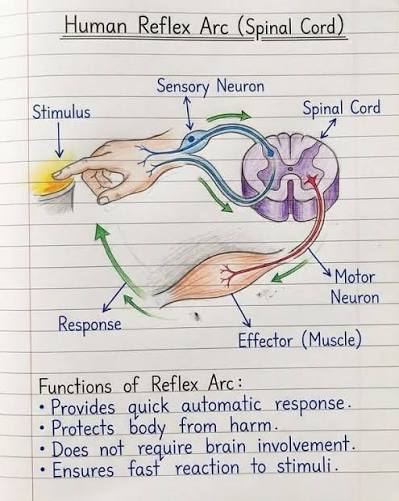
Stretch a muscle quickly and it fires straight back, automatically. That’s the free energy behind a countermovement jump, and the reason you dip before you leap. The little dip isn’t hesitation — it’s you cocking the spring.
Tension in the tendon feeds a second stream of information back into the spinal cord, and that can turn your effort down — though how much, and sometimes even in which direction, depends on the task. Think of it less as a safety cut-out and more as a gauge the system reads differently depending on the job.
Training changes how both get used. Part of getting more explosive is the system learning to weight that feedback differently, which is not the same as switching a protective brake off.
The advanced section below gives these reflexes their proper names — muscle spindles and Golgi tendon organs — and shows the wiring. For now, just know they’re on duty in every session, and how you train changes how they behave.
Feeling flat? Blame the manager, not the crew
When athletes feel flat, they usually blame their muscles. Often the muscles are fine.
What hasn’t reset is readiness — the whole neuromuscular system, brain and spinal cord included. It recovers on a different timetable to soreness, driven heavily by sleep and by how much hard, high-effort work has piled up recently.
Play that out across a training week. A week of maximal lifting and sprinting can leave you with fresh legs and a manager who has quietly stopped calling in the full crew. Legs feel great. Bar crawls anyway.
The tells are sneaky, too. Watch for:
- Bar speed or jump height dropping while your muscles feel fresh
- Motivation draining away for no obvious reason
- Scrappy sleep, or a resting heart rate that has crept up
None of those tell you where the fatigue actually sits. They tell you output is down, which is enough to act on.
This is why deloads exist. Not because muscle alone needs a holiday — because the whole system does.
Recap: soreness tracks the crew; flatness tracks the manager.
Strength is a team sport
Calling in more workers only helps if they pull in the same direction at the same moment.
Untrained movement is full of muscles bracing against each other. That’s why a beginner’s heavy lift looks like a fight. It is one — and half the opponents are their own muscles.
Training teaches the system to let the parts that should be quiet stay quiet. Your hamstrings learning to relax while your quads straighten the knee, for instance, so the two stop wrestling each other.
A lot of what looks like new strength is really the removal of self-inflicted resistance. You didn’t add horsepower. You took the handbrake off.
It only learns what you rehearse
The nervous system is fussy about specifics. It doesn’t learn strength in the abstract — it learns this movement, at this speed, in this position.
That’s why someone can squat an enormous weight and still jump badly. The squat strength is real; the jump simply hasn’t been rehearsed.
It’s also why practising something slowly does very little for a quality that has to appear fast. Slow rehearsal teaches slow.
So match the practice to the point. Even with a light bar, moving with genuine intent is rehearsal for moving fast. And if you want a quality in competition, rehearse it close to how it will show up there — same speed, same positions.
Recap: the system gives back exactly what you rehearse. Choose your rehearsals accordingly.
Want the wiring diagram? Keep going. The rest of the article covers motor units and the order they’re recruited in, rate coding, the specific reflexes and what training does to them, and how fatigue shows up in testing. It’s more technical, so save it for when you want the mechanism rather than the picture.
Advanced Section: How the Nervous System Governs Force and Movement
Motor Units, Recruitment, and Rate Coding — A Deeper Look
As introduced in the first article, a motor unit consists of a motor neuron and every muscle fiber it innervates. Two mechanisms determine how forcefully a muscle contracts:
- Recruitment follows Henneman's size principle: Smaller, lower-threshold motor units (controlling fatigue-resistant, lower-force fibers) are recruited first for light tasks, with progressively larger, higher-threshold motor units (controlling powerful, fast-fatiguing fibers) brought in as demand rises (Purves et al., 2018). Heavy loads reach those high-threshold units early in a set and are the most specific stimulus for maximal (1RM) strength, but lighter loads taken close to failure also recruit them as fatigue accumulates and lower-threshold units drop out (Beausejour et al., 2024). What leaves them under-trained is easy work stopped well short of hard.
- Rate coding is the frequency at which a recruited motor unit fires. A single nerve impulse produces a brief "twitch," but repeated impulses in quick succession cause the twitches to summate, producing sustained, more forceful contraction (a state called tetanus). Higher rate coding produces both more force and faster force development (Enoka & Duchateau, 2017).
Reflexes That Regulate Force in Real Time
- Muscle spindle and the stretch reflex: Muscle spindles are stretch-sensitive receptors embedded within the muscle belly. When a muscle is stretched quickly, the spindle triggers a reflexive contraction (the stretch reflex) to resist further stretch and protect the muscle. This reflex is central to the stretch-shortening cycle discussed in the plyometrics section of this series — much of the "free" elastic power in a jump comes partly from this reflex loop, not just passive tissue recoil.
- Golgi tendon organ (GTO) and Ib feedback: GTOs are tension-sensitive receptors located at the muscle-tendon junction. Their Ib afferents report tendon tension into the spinal cord, where that signal is combined with spindle, joint and skin input and with descending drive from the brain. The traditional textbook account — a protective cut-out that shuts the muscle down at dangerous tensions and can be trained away — is not well supported in humans: Ib effects are task-dependent, can be inhibitory or facilitatory depending on the movement and its phase, and are regulated moment to moment by spinal and supraspinal control (Chalmers, 2002). Training appears to change how that feedback is weighted within a task, which is not the same as withdrawing a safety brake (Aagaard et al., 2002).
- Reciprocal inhibition: When an agonist muscle contracts, the nervous system automatically reduces activation of its direct antagonist, allowing smooth, unopposed movement (e.g., the hamstrings relax as the quadriceps contract to extend the knee) (Purves et al., 2018).
Proprioception and the Vestibular System
Proprioception is the body's sense of its own position and movement in space, built from a combination of muscle spindles, joint receptors, and skin receptors. It allows an athlete to make fine adjustments to balance and positioning without needing to look at their limbs — essential for everything from landing a jump to maintaining posture during a grapple.
The vestibular system, located in the inner ear, detects head position and acceleration, contributing to balance and spatial orientation. It works closely with the visual system and proprioception to maintain stability, and training that challenges balance (single-leg work, unstable surfaces in moderation) can improve the integration of these systems, which is particularly relevant to change-of-direction sports and combat sports where balance is constantly challenged by an opponent.
Neuromuscular Fatigue: Peripheral and Central Contributions
Fatigue during and after training is not a single phenomenon:
- Peripheral fatigue occurs within the muscle itself — depleted fuel stores, accumulated metabolic byproducts, and impaired calcium handling within the muscle fiber all reduce its ability to produce force (Gandevia, 2001).
- Central fatigue occurs upstream in the brain and spinal cord — a reduced drive to recruit motor units. It is real, but it is measured with techniques such as interpolated twitch and transcranial stimulation, not inferred from how an athlete feels (Gandevia, 2001). When performance stays down for days after extremely demanding training (maximal strength work, high-volume eccentric work, and high-speed/high-impact work such as sprinting and jumping), the central contribution is usually not the main driver — peripheral, contractile factors tend to dominate the slow part of the recovery (Thomas et al., 2018).
In the gym you cannot separate the two. What you can track is readiness: unexplained drops in bar speed or jump height despite feeling muscularly fresh, reduced motivation or "flatness," disrupted sleep, and elevated resting heart rate. Treat these as nonspecific monitoring tools — they show that output or willingness to work has fallen, not which part of the system is responsible, and none of them diagnoses central fatigue. That is still worth watching, because fatigue that shows up as feeling unmotivated is frequently under-recognized in athletes who otherwise track muscular soreness carefully.
Practical Section: Training and Managing the Nervous System
- Train with high force or high effort to reach high-threshold motor units: Loads above roughly 85% of a 1-rep max and maximal-intent explosive efforts are the most direct route and the most specific to maximal strength; sets with lighter loads taken close to failure reach those units as well, once fatigue forces the system to call on them (Sale, 1988; Beausejour et al., 2024).
- Use full-recovery rest periods for neural-quality work: 2-5 minutes between sets for maximal strength or power work allows the nervous system (and phosphocreatine stores) to recover enough to maintain quality.
- Respect the most demanding sessions in weekly planning: Heavy max-effort strength work, maximal sprinting, and high-intensity plyometrics should generally not be stacked back-to-back without adequate spacing.
- Monitor readiness, not just soreness: Simple tools like a jump test, grip strength test, or even subjective readiness questionnaires can flag a drop in readiness before it shows up as a performance decline in competition. They are nonspecific — useful for spotting a trend against an athlete’s own baseline, not for diagnosing where the fatigue sits.
- Include balance and proprioceptive work: Brief single-leg and reactive balance drills support the sensory side of neuromuscular control, complementing the strength side.
Sport Applications
- mixed martial arts (MMA)/Wrestling/Brazilian jiu-jitsu (BJJ): Heavy reliance on proprioception and reactive reflexes during scrambles and grip fights, where athletes must produce and adjust force in unpredictable, constantly changing positions.
- Football/Rugby: Extremely high neuromuscular demand from repeated maximal-effort collisions and sprints, a major reason these sports require careful in-season load management.
- Basketball/Volleyball: The stretch reflex and reactive strength of the lower body are central to repeated jumping performance across a game.
- Olympic weightlifting/Sprinting: Among the most neurally demanding sports in existence, requiring both extremely high-threshold motor unit recruitment and precise timing/coordination.
- Tennis/Baseball: Proprioception and reactive adjustment are critical given the very short reaction windows involved in returning a serve or hitting a pitch.
Common Mistakes
Size Principle of Motor Unit Recruitment Explained — The Movement System. The size principle in a few minutes, and why both heavy loads and hard efforts reach high-threshold units.
- Only training in moderate rep ranges and never with true maximal intent, leaving the highest-threshold motor units under-trained.
- Treating all fatigue as muscular and only monitoring soreness, missing a broader drop in readiness.
- Stacking multiple maximal-effort, highly neurally demanding sessions too close together in a training week.
- Neglecting balance and proprioceptive training in sports where it is highly relevant (combat sports, field sports).
Coaching Cues
- "Move it like it's heavy, even when it's light" (to train intent and rate coding on submaximal loads).
- "Fresh nervous system, quality reps — tired nervous system, junk volume."
- "Feeling unmotivated can be a symptom, not just a mood."
FAQs
Why do I get stronger in the first few weeks of training before I look any different?
Early strength gains are driven mostly by neural adaptations — improved motor unit recruitment, rate coding, and coordination — which happen faster than measurable muscle growth (hypertrophy), which generally takes 6-8+ weeks to become visible (Sale, 1988; Häkkinen & Komi, 1983).
How long does this kind of fatigue take to recover from?
It varies widely with training history and the demand of the session, but measurable performance decrements after very high-intensity work can persist for 48-96 hours, sometimes longer after extremely demanding efforts such as a maximal-intensity competition (Thomas et al., 2018). That is an observed recovery time for performance, not a measurement of the nervous system.
Can you train reflexes directly?
You cannot change the basic reflex arc itself, but you can train the nervous system to modulate reflex sensitivity and reaction speed through repeated, sport-specific practice — this is part of why reactive strength and agility training (covered later in this series) is so specific to the demands it targets.
Recommended Videos
Muscle Spindle vs. Golgi Tendon Organ – Explained — The Movement System
Watch on YouTube
A concise, visual explanation of the two key reflex receptors discussed above and how they oppose and balance each other during movement.
The Science of Training Your Nervous System: What Every Advanced Coach Should Know — The Movement System. Connects nervous-system adaptation to practical training decisions instead of leaving it abstract.
Rate Coding Explained (Neuromuscular Adaptation to Resistance Training) — The Movement System
Watch on YouTube
Directly expands on the rate coding and motor unit recruitment concepts covered in this article, with clear visuals of the underlying electrophysiology.
References
Aagaard, P., Simonsen, E. B., Andersen, J. L., Magnusson, P., & Dyhre-Poulsen, P. (2002). Neural adaptation to resistance training: Changes in evoked V-wave and H-reflex responses. Journal of Applied Physiology, 92(6), 2309-2318.
Beausejour, J. P., Knowles, K. S., Pagan, J. I., et al. (2024). The effects of resistance training to near volitional failure on motor unit recruitment during neuromuscular fatigue. PeerJ, 12, e18163. Read on PMC
Chalmers, G. (2002). Strength training: Do Golgi tendon organs really inhibit muscle activity at high force levels to save muscles from injury, and adapt with strength training? Sports Biomechanics, 1(2), 239–249. Read on Europe PMC
Enoka, R. M., & Duchateau, J. (2017). Rate coding and the control of muscle force. Cold Spring Harbor Perspectives in Medicine, 7(10), a029702.
Gandevia, S. C. (2001). Spinal and supraspinal factors in human muscle fatigue. Physiological Reviews, 81(4), 1725-1789.
Häkkinen, K., & Komi, P. V. (1983). Electromyographic changes during strength training and detraining. Medicine and Science in Sports and Exercise, 15(6), 455-460.
Purves, D., Augustine, G. J., Fitzpatrick, D., et al. (Eds.). (2018). Neuroscience (6th ed.). Oxford University Press.
Sale, D. G. (1988). Neural adaptation to resistance training. Medicine and Science in Sports and Exercise, 20(Suppl. 1), S135-S145.
Thomas, K., Brownstein, C. G., Dent, J., Parker, P., Goodall, S., & Howatson, G. (2018). Neuromuscular fatigue and recovery after heavy resistance, jump, and sprint training. Medicine & Science in Sports & Exercise, 50(12), 2526–2535. Read on PubMed
Medical disclaimer. FitXplor publishes general performance and health education, not individualised medical advice. Nothing here diagnoses, treats or replaces assessment by a qualified clinician. Stop and seek assessment if you have pain that does not settle, swelling, instability, numbness or weakness, a recent injury, surgery or concussion, or if you are pregnant, under 18, or managing a medical condition or medication. Supplement, rehabilitation and mental-health guidance in particular should be reviewed with a qualified professional before you act on it.
.png)