Start here: what to do
Your hands often end the set before your back does. Fix that end of the chain.
- Check if your hands are the cap. Does the bar creep to your fingertips? Do your hands pop open at rep 7 while your back has more? Then grip is the limit, and the target muscle never finished the set.
- Train all 3 grips. Crushing a handle, hanging from a bar, and pinching a plate are separate skills. Being good at one buys little in the others. Try dead hangs, 3 sets of 30 to 45 seconds. Add farmer's carries, 4 trips of 30 m. Add plate pinch holds, 3 sets of 20 seconds.
- Train the openers too. Put a band round your fingers and spread them, 2 sets of 25. Almost nothing else in a training week loads those muscles. Heavy gripping with no opening work is the usual road to pain on the outside of the elbow.
- Strap for the target, not for the grip. If the set is meant to build your back, and your grip quits first, use straps. If the set is meant to build grip, or your sport is a gripping sport, take them off. Straps on every pull, with no grip work at all, is the trap.
- Keep the wrist stacked. Hold it straight, or just slightly back. Let it fold under a front rack, a bench press, or a punch, and the load lands on the joint instead of passing through the arm.
- Load a sore outer elbow, do not rest it. Start with wrist extension holds, 5 rounds of 45 seconds, daily. After 2 weeks, move to slow reps, 3 sets of 15, 3 seconds up and 3 seconds down, every other day. Add 2 to 5% a week, not 10%.
Pain rule. Keep pain at 3 out of 10 or less while you work. It must be normal again by the next morning. Worse 24 hours later means the dose was too big.
Expect this to take months. Tendon builds far slower than muscle. A mild ache that settles is fine and expected. Judge it by what you can hold and how you feel next day, not by a pain free week.
Safety. This is general coaching information, not medical advice. Rehab and return to sport are your clinician's call, not a training plan's. Get checked for pain that will not settle, swelling, numbness, pins and needles, weakness or a hand that drops things, or recent injury or surgery.
Executive summary
- What this article covers. How the forearm, elbow and wrist finish the kinetic chain, why grip is a nervous-system output before it is a muscular one, how tendon tissue in this region tolerates load differently from muscle, and how to build hands, wrists and elbows that survive heavy pulling, striking, gripping and overhead work.
- Who benefits. Lifters whose grip fails before their back does, climbers and grapplers, throwing and racket athletes, combat athletes, tradespeople using tools all day, keyboard-bound professionals with wrist and elbow pain, and coaches who currently prescribe nothing below the shoulder.
- Main takeaways. The wrist and elbow are mostly passive conduits — their job is stiffness and load tolerance, not motion. Grip strength is a validated proxy for whole-body strength and even mortality risk, but it is highly task-specific. Tendon adapts to load slowly and needs longer time-under-tension than muscle. Most "tennis elbow" is a load-tolerance failure, not an inflammatory one, and it responds to progressive loading rather than rest.
- Key performance outcomes. Higher usable strength in every pulling lift, faster hand speed in striking and racket sports, better bar and implement control overhead, reduced elbow and wrist pain under repeated load, and improved carry-over from gym strength to sport strength.
Why the far end of the chain decides what the rest of it can do
Most sets do not end because the big muscles gave up. They end because your hands did.
You have felt it. The bar starts rolling toward your fingertips on the last deadlift. Your hands pop open at rep seven of a pull-up set while your back still has more to give. The lift ends, and the muscle you were trying to train never actually got finished off.
That is a grip problem pretending to be a strength problem, and it is enormously common — because almost nobody trains the far end of the arm on purpose.
It matters beyond the gym too. Grip strength is one of the most reliable single numbers in health research, and it is not because strong hands are magic. It is because your hands quietly report on the rest of you.
One more thing that surprises people: grip is not one skill. Crushing a handle, hanging from a bar and pinching a plate are three different abilities, and being good at one buys you very little in the others. The rest of this section explains why.
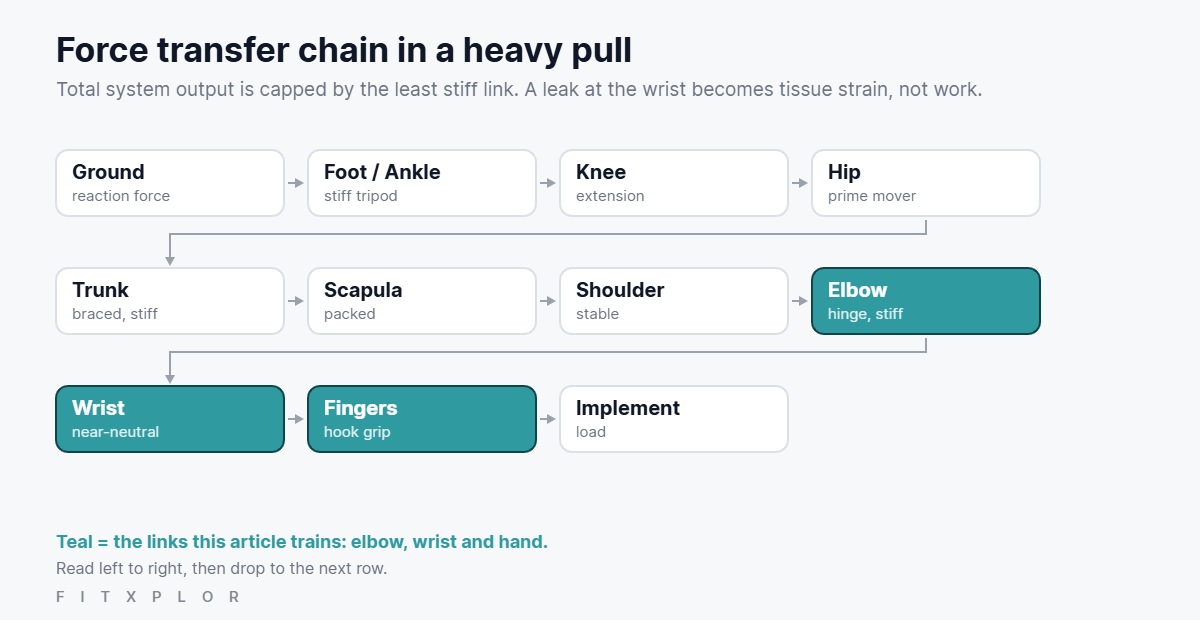
Article 4.7 finished with the trunk transmitting force between hips and shoulders. That force still has to reach something — a barbell, a gi lapel, a racket, a hammer, an opponent. The last link in that chain is the forearm, wrist and hand, and it is routinely the weakest one. A deadlift is not limited by the erectors if the bar rolls out of the fingers first. A pull-up set is not limited by the lats if the hands open at rep seven. A boxer does not transmit hip rotation into a target if the wrist collapses on impact.
This produces a strange coaching blind spot. The hip and shoulder get whole training blocks; the elbow and wrist get an afterthought, usually a few sets of curls. Yet the tissues here are small, poorly vascularised in places, and asked to tolerate very high forces relative to their cross-section. They are also the region where a large fraction of overuse pain in both sport and manual work actually shows up.
An analogy for beginners: The rope and the winch
Imagine a powerful electric winch attached to a load by a thin rope. The winch is your hips, trunk and back. The rope is your forearm and grip. It does not matter how much torque the winch produces — the system moves exactly as much load as the rope will hold. Upgrading the winch when the rope is the limit is wasted money.
Two things follow. First, if the rope is your limiter, thickening the rope produces immediate strength gains everywhere. Second, a rope does not "contract" — it holds. That is why most useful wrist, elbow and grip training looks like holding, resisting and bracing rather than curling and flexing.
What the wrist and elbow actually contribute
The elbow is a hinge with a rotational partner. Flexion and extension happen at the humero-ulnar and humero-radial joints; pronation and supination happen as the radius rotates around the ulna at the proximal and distal radioulnar joints. This split matters because most elbow pain is a pronation-supination and gripping problem masquerading as a flexion-extension problem.
The wrist is a stack of eight carpal bones in two rows, and it is best understood as a stiffness-modulating platform rather than a mobile joint. Under load, the wrist's role is to hold a position — usually close to neutral or slightly extended — so that force passes through the forearm rather than being absorbed by soft tissue at the joint margins.
The advanced view: Anatomy, tendon mechanics and neural drive
Muscular organisation of the forearm
The forearm is organised into a flexor-pronator group on the anterior side and an extensor-supinator group on the posterior side. Almost all of the superficial flexors share a common origin on the medial epicondyle of the humerus; almost all of the superficial extensors share a common origin on the lateral epicondyle. Two consequences follow directly from that shared anatomy.
- Grip loads the elbow. Closing the hand hard contracts flexor digitorum profundus and superficialis, which cross both the wrist and the elbow. Every hard grip therefore applies tensile load at the medial epicondyle, which is why "golfer's elbow" appears in people who never swing a club but do carry heavy things.
- Wrist extension stabilises grip. To make a strong fist you must simultaneously extend the wrist, because the finger flexors need a lengthened, tensioned position to generate force. Extensor carpi radialis brevis is the primary wrist stabiliser during gripping, and it is also the tendon most commonly implicated in lateral elbow pain. Grip strength and lateral elbow pain are therefore mechanically linked, not coincidentally associated.
The four grip types — and why they do not transfer to each other
Grip is not one quality. Training one type produces surprisingly little improvement in the others, which is why an athlete can have a huge deadlift hold and a weak pinch, or a crushing handshake and a hand that fails on a thick bar.
| Grip type | Mechanical demand | Primary tissue | Sport / occupational relevance | Trained by |
|---|---|---|---|---|
| Support (hook / holding) | Isometric endurance with fingers as hooks; thumb largely passive | Long finger flexors, flexor tendon sheaths | Deadlift, farmer's carry, gi grips, luggage, tools | Dead hang, farmer's carry, heavy holds |
| Crush | Force between fingers and palm; full-hand closure | FDP/FDS plus intrinsics | Clinching, handshake strength, hand tools, climbing jugs | Grippers, thick-handle rows, towel pull-up |
| Pinch | Thumb opposition against finger pads; no palm contact | Thenar group, adductor pollicis | Plate handling, gi lapel, block climbing, sheet metal, glass | Plate pinch hold, pinch carries |
| Extension / open hand | Finger and wrist extension against resistance | Extensor digitorum, ECRB/ECRL | Antagonist balance, elbow health, throwing deceleration | Band finger extension, reverse curl, wrist roller |
Tendon is not muscle
The single most useful piece of physiology for this region is that tendon adapts on a different timescale and to a different stimulus than muscle. Tendon is dense, largely type I collagen, sparsely vascularised, and mechanically responsive to strain magnitude and duration rather than to metabolic stress.
- Slow turnover. Collagen synthesis rises after loading but the net remodelling of a tendon takes weeks to months, not days. This is why elbow and wrist tendinopathy does not resolve on a four-week plan and why load must be increased in smaller increments than for muscle.
- Strain, not speed. Tendon responds best to moderate-to-high strain held long enough to deform the tissue — roughly 30 to 60 seconds of cumulative loading per set is a commonly used target in tendon rehabilitation, which is why heavy slow resistance and long isometrics dominate the evidence base.
- Refractory period. After a loading bout, tendon appears to be relatively unresponsive to further stimulus for a period of hours. Practically, one quality loading session every 24 to 48 hours beats several small ones on the same day.
- Degeneration, not inflammation. Chronic tendinopathy shows disorganised collagen, increased ground substance and neovascularisation — a failed healing response rather than classic inflammation. That is the reason rest and anti-inflammatories relieve symptoms temporarily but rarely restore capacity, while progressive loading does.
Grip strength as a systemic marker
Handgrip dynamometry is one of the most-studied measurements in all of human performance and public health, for a simple reason: It is cheap, reliable, and correlates with things far away from the hand. Grip strength tracks with total lean mass, with bone mineral density, with functional independence in older adults, and — in large prospective cohorts — with all-cause and cardiovascular mortality independent of many conventional risk factors.
The correct interpretation is not that squeezing a dynamometer improves your health. It is that grip is a low-noise readout of a person's overall neuromuscular condition. For a coach, that makes it a genuinely useful monitoring tool: An unexplained multi-day drop in morning grip strength is a reasonable soft flag for accumulated fatigue, sleep debt or under-recovery, and it costs nothing to collect.
Neural drive, irradiation and the grip-strength trick
Maximal grip is heavily limited by neural drive rather than by forearm cross-section. Two well-documented phenomena follow.
First, irradiation: A hard grip increases motor unit recruitment in muscles further up the chain. Squeezing the bar aggressively measurably improves shoulder stability and can improve pressing and pulling output. This is why "crush the bar" is a legitimate cue rather than gym folklore.
Second, bilateral and postural dependence: Grip force output changes with wrist angle, elbow angle, shoulder position and even trunk posture. Grip is strongest with the wrist slightly extended and the elbow near 90 to 120 degrees. Tested in full wrist flexion, the same hand may lose 30 percent or more of its output because the finger flexors are shortened past their optimal length. Any grip test or grip prescription without a specified joint position is close to meaningless.
The practical section: Building load tolerance below the shoulder
Four training targets, in priority order
- Support-grip endurance. The ability to hold on. This is the single highest-return quality for lifters, grapplers and manual workers, and it responds fast because it is largely neural and endurance-based.
- Wrist and forearm stiffness. The ability to hold the wrist near neutral against a bending moment. This is what protects the joint under a heavy front rack, a bench press, an overhead lockout or a punch.
- Elbow tendon load tolerance. Progressive tolerance to tension at the medial and lateral epicondyles, built with slow heavy work and long isometrics.
- Extensor and intrinsic balance. Deliberate work for finger and wrist extension, which almost nobody trains and which is disproportionately protective.
Dose: What the numbers actually look like
| Quality | Load | Time under tension | Sets | Frequency | Rest |
|---|---|---|---|---|---|
| Support-grip endurance | Bodyweight to heavy carry load | 20–60 s per set | 3–5 | 2–4×/week | 60–120 s |
| Maximal support grip | Heavier than deadlift 1RM if using straps-off holds | 8–15 s | 3–5 | 1–2×/week | 2–3 min |
| Crush grip | RPE 8–9 gripper or thick handle | 5–20 s | 3–5 | 2×/week | 90–120 s |
| Pinch grip | Load that fails at 15–30 s | 15–30 s | 3–4 | 2×/week | 90 s |
| Tendon (heavy slow resistance) | RPE 7–8, 3 s down / 3 s up | 36–45 s per set | 3–4 | Every 48 h | 2 min |
| Tendon (isometric, pain relief) | ~70% MVC | 30–45 s × 4–5 | 4–5 | Daily acceptable | 60 s |
| Wrist stiffness | Light, position-controlled | 20–40 s | 2–3 | 3–5×/week | 45 s |
| Extensor / intrinsic | Band or very light | 30–60 s or 15–25 reps | 2–3 | 3–5×/week | 45 s |
A sample week for a lifter with a grip-limited deadlift
| Day | Main work | Forearm / grip block |
|---|---|---|
| Mon | Deadlift, straps off to a top single, then straps on for volume | Heavy hold at 105% of best straps-off deadlift × 3 × 10 s; plate pinch hold 3 × 20 s |
| Tue | Press | Wrist roller 3 × up-and-down; band finger extension 2 × 25 |
| Wed | Off / conditioning | Dead hang 3 × 30–45 s |
| Thu | Squat | Reverse curl 3 × 12 at 3 s eccentric |
| Fri | Pull-ups and rows, all straps off | Towel pull-up 3 × AMRAP; farmer's carry 4 × 30 m |
| Sat | Optional | Band finger extension 2 × 25 (recovery dose) |
What each element in the week is doing
- Deadlift straps off to a top single, then straps on for volume (Monday). The straps-off single trains and tests grip at maximal load. Strapping up for the volume work means the back and hips get their full stimulus instead of stopping when the hands give out.
- Heavy hold at 105 percent of the best straps-off deadlift, 3 x 10 s. Overloads the grip isometrically above what can be pulled, which is the most direct way to raise the ceiling on support grip.
- Plate pinch hold, 3 x 20 s. Trains pinch grip, a separate quality from crush and support grip, and one that no barbell exercise develops.
- Wrist roller, 3 up-and-down (Tuesday). Loads the wrist flexors and extensors through full range with continuous tension, building forearm endurance rather than peak strength.
- Band finger extension, 2 x 25. Trains the finger extensors, which almost nothing else in a training week loads. Balancing them against heavy gripping is the main defence against lateral elbow pain.
- Dead hang, 3 x 30 to 45 s (Wednesday). Builds support-grip endurance and decompresses the shoulder, at a cost low enough to sit on an otherwise easy day.
- Reverse curl, 3 x 12 with a 3 s eccentric (Thursday). Loads the wrist extensors and brachioradialis eccentrically, which is the loading pattern with the best support for tendon capacity at the lateral elbow.
- Pull-ups and rows with all straps off (Friday). Uses the day’s pulling volume as grip volume, so grip is trained inside work that is happening anyway.
- Towel pull-up, 3 x as many reps as possible. Removes the bar as a rigid handle and forces the fingers to hold a thick, deforming surface, which is closer to the demands of grappling and climbing.
- Farmer’s carry, 4 x 30 m. Trains support grip under time and load simultaneously, and doubles as trunk and postural endurance work.
- Band finger extension as a recovery dose (Saturday). A very low-load exposure that promotes blood flow through a forearm that has been loaded five days running.
The strap question, settled
Straps are a tool, not a moral failing, and the useful rule is simple: Strap for the target, not for the grip. If the purpose of the set is back hypertrophy or hip extension volume, and grip is the limiter, strap up so the target tissue actually gets the stimulus. If the purpose of the set is to build grip, or the sport itself is a grip sport, take the straps off and accept lower loads. Athletes get in trouble when straps are used on every pulling set for years and grip is then never trained anywhere else.
Monitoring fatigue with the hands
Grip is a convenient daily readiness marker. Take three maximal squeezes on a dynamometer at a fixed elbow and wrist angle, first thing, three days a week, and use a rolling seven-day baseline. A single low reading is noise. Two or three consecutive readings more than roughly 10 percent below baseline, especially alongside disturbed sleep or elevated resting heart rate, is a reasonable prompt to cut volume rather than intensity for a few days.
Common mistakes
- Treating elbow pain as an inflammation problem. Rest and ice reduce symptoms and reduce capacity at the same time. Load, dosed correctly, is the treatment.
- Only training flexion. Curls and grippers with no extensor work builds an imbalance that shows up as lateral elbow pain.
- Chasing pain-free instead of load-tolerant. A mild, settling, next-morning-normal ache during tendon rehabilitation is acceptable and expected. Sharp pain, or pain that is worse 24 hours later, means the dose was wrong.
- Wrist collapse under load. Letting the wrist fall into extension in a front rack, a bench press or a punch converts force transfer into joint strain.
- Progressing tendon work like muscle work. Adding 10 percent per week to a heavy slow resistance protocol will outrun collagen remodelling. Two to five percent is a saner increment.
- Testing grip in a random position. Wrist and elbow angle change the number more than a month of training does.
Return-to-load progression for lateral elbow pain
Sport applications
| Sport | Dominant demand at wrist / elbow / hand | Priority training | Watch for |
|---|---|---|---|
| MMA | Clinch and gi-less grip fighting, wrist stiffness on impact, elbow tolerance to frames and posts | Support holds, thick-bar work, wrist isometrics in a closed fist, band extension | Medial elbow load from constant gripping plus striking volume in the same week |
| Boxing | Wrist stiffness at impact; the fist must be a rigid extension of the forearm | Closed-fist wrist isometrics, knuckle push-ups on a firm surface, forearm stiffness work | Wrist extension collapse on hooks; carpal irritation from poor wrapping |
| Wrestling | Crush and support grip in ties, repeated maximal gripping under fatigue | Crush grip, heavy carries, rope climbs | Cumulative medial epicondyle load across a season |
| BJJ | Pinch grip on lapels, sustained isometric finger flexion, wrist tolerance in guard frames | Pinch holds, gi-towel pull-ups, finger extension for balance | Finger flexor tendon and pulley irritation; interphalangeal joint thickening |
| Football (American) | Hand fighting for linemen, catching for skill positions, wrist stiffness in the punch | Crush and open-hand grip, wrist isometrics, extension work | Thumb and wrist sprains; extensor overload in linemen |
| Soccer | Low for field players; very high for goalkeepers (catch, parry, land) | GK: Wrist stiffness, finger extension, impact-tolerant push-ups | Finger dislocations, wrist hyperextension on landing |
| Ice hockey | Stick control, wrist snap in shooting, cross-hand grip endurance | Wrist roller, forearm pronation-supination strength, support grip | Ulnar-side wrist pain from repeated snap loading |
| Basketball | Ball control, catch under contact, wrist snap in the shot | Wrist and finger extension, light snap-specific work | Finger sprains; wrist tolerance in shooting volume spikes |
| Volleyball | Blocking and setting impact through wrist and fingers | Wrist stiffness in extension, finger extensor work | Finger extensor strain; wrist impingement in blockers |
| Baseball | Very high — valgus load at the medial elbow in throwing; wrist snap in hitting | Medial elbow tolerance, forearm pronator strength, grip endurance, careful volume control | Medial elbow (UCL) load; this is a volume-management problem first and a strength problem second |
| Sprinting | Low direct demand; arm action requires relaxed hands | Nothing specialised; avoid gripping tension in the hands during sprints | Clenched fists raising upper-body tension and cadence cost |
| Olympic weightlifting | Hook grip tolerance, extreme wrist extension in the front rack and jerk, elbow speed under load | Wrist extension mobility plus stiffness, hook grip conditioning, pronation-supination strength | Thumb pain from hook grip; wrist pain in the front rack from limited extension |
| Powerlifting | Support grip on deadlift, wrist stacking on bench and overhead | Heavy holds, wrist isometrics, extensor balance | Bar rollout; wrist extension collapse on bench |
| Rugby | Tackling, carrying, grip in contact and in the scrum | Crush grip, carries, wrist stiffness | Finger and thumb injuries; wrist load in contact |
| Tennis | The archetype: Repeated eccentric wrist extensor load on off-centre impact | Heavy slow resistance wrist extension, forearm pronator strength, grip sizing | Lateral epicondyle load tolerance; grip size and string tension are part of the load equation |
Exercise library for the forearm, wrist and elbow
Dead Hang
- Purpose. Support-grip endurance plus a decompressive traction stimulus for the shoulder and thoracic spine.
- Primary muscles. Flexor digitorum profundus and superficialis, flexor carpi ulnaris.
- Secondary. Lower trapezius, latissimus dorsi, forearm intrinsics.
- Movement pattern. Isometric support hold.
- Difficulty. Beginner.
- Equipment. Pull-up bar.
- Coaching cues. "Fingers are hooks, not clamps." "Shoulders active, not shrugged to the ears." "Breathe — this is an endurance set."
- Common mistakes. Hanging completely passively with no scapular engagement; letting the thumb do the work; holding the breath.
- Progressions. Thick bar → towel hang → single-arm assisted hang → weighted hang.
- Regressions. Feet lightly supported on a box; shorter holds with more sets.
- When to use. Any time; extremely low systemic cost. Excellent as a filler between main sets.
- When not to use. Acute shoulder impingement or an irritable finger pulley.
- Programming. 3–5 × 20–60 s, 2–4×/week.
Farmer's Carry
- Purpose. Support-grip endurance under a genuinely heavy load, with simultaneous trunk and postural demand.
- Primary muscles. Finger flexors, forearm flexor group.
- Secondary. Upper trapezius, erector spinae, obliques, glutes.
- Movement pattern. Loaded gait / bilateral carry.
- Difficulty. Beginner to advanced by load.
- Equipment. Farmer's handles, trap bar, dumbbells or kettlebells.
- Coaching cues. "Tall through the crown of the head." "Ribs down, don't lean back." "Short, quiet steps."
- Common mistakes. Leaning away from the load; shrugging into the ears; walking so far that posture degrades before grip does.
- Progressions. Thick handles → single-arm suitcase carry → timed heavy medley.
- Regressions. Shorter distance, lighter load, or a stationary hold.
- When to use. End of a lower-body or pulling session; excellent general-preparation work for every field and combat sport.
- When not to use. When trunk position cannot be maintained, or with an irritable medial elbow in the first two weeks of rehabilitation.
- Programming. 3–5 × 20–40 m, or 3–4 × 30–45 s.
Wrist Roller
- Purpose. Balanced flexor and extensor endurance through full wrist range, with very high time under tension.
- Primary muscles. Wrist flexor and extensor groups.
- Secondary. Finger flexors, anterior deltoid (isometric hold).
- Movement pattern. Alternating wrist flexion-extension against a hanging load.
- Difficulty. Beginner.
- Equipment. Wrist roller and plate.
- Coaching cues. "Elbows fixed, only the wrists move." "Roll both directions, equal work." "Small load, long set."
- Common mistakes. Loading it heavily enough that the shoulders take over; rolling only in the flexion direction.
- Progressions. Arms extended in front rather than at the sides; heavier plate; slower cadence.
- Regressions. Rest the elbows on a bench or rack.
- When to use. Accessory slot on pressing or pulling days; extremely useful in racket and stick sports.
- When not to use. Acute, highly irritable wrist tendinopathy before isometrics have been tolerated.
- Programming. 2–4 sets of one full up-and-down cycle each direction.
Plate Pinch Hold
- Purpose. Thumb-opposition (pinch) strength, the least-trained and most transferable grip quality for grappling and trades.
- Primary muscles. Thenar group, adductor pollicis, flexor pollicis longus.
- Secondary. Finger flexors, forearm intrinsics.
- Movement pattern. Isometric pinch.
- Difficulty. Intermediate.
- Equipment. Two smooth plates, or a pinch block.
- Coaching cues. "Thumb pad against finger pads — no palm contact." "Squeeze from the base of the thumb." "Chalk, not a death grip on the rim."
- Common mistakes. Letting the plates rest against the palm; using textured plates that remove the pinch demand.
- Progressions. Heavier plates → wider pinch → pinch carry → single-plate pinch.
- Regressions. Lighter plates, shorter holds, or a narrower block.
- When to use. Two sessions a week for grapplers, climbers and anyone handling flat materials at work.
- When not to use. Active thumb-base (first CMC) joint pain.
- Programming. 3–4 × 15–30 s per hand.
Reverse Curl
- Purpose. Load the wrist extensors and brachioradialis directly — the primary antagonist-balance exercise for lateral elbow health.
- Primary muscles. Extensor carpi radialis brevis and longus, brachioradialis.
- Secondary. Extensor digitorum, biceps brachii, brachialis.
- Movement pattern. Pronated elbow flexion.
- Difficulty. Beginner.
- Equipment. Barbell, EZ bar or dumbbells.
- Coaching cues. "Knuckles lead the way up." "Wrist stays stacked — don't let it drop." "Three seconds down."
- Common mistakes. Loading it like a biceps curl and losing wrist position; swinging from the shoulder.
- Progressions. Slow eccentric → heavy slow resistance tempo → thick-bar reverse curl.
- Regressions. Light dumbbells, or a seated version with the forearm supported.
- When to use. Every upper-body session for racket, throwing and combat athletes, and anyone with a history of lateral elbow pain.
- When not to use. Only if it reproduces sharp pain; substitute isometric wrist extension until tolerated.
- Programming. 3 × 10–15 with a 3-second eccentric, twice weekly.
Towel Pull-Up
- Purpose. Combine crush-grip demand with vertical pulling; the closest gym analogue to gi and rope gripping.
- Primary muscles. Finger flexors, latissimus dorsi.
- Secondary. Biceps brachii, brachioradialis, lower trapezius, trunk.
- Movement pattern. Vertical pull with a closed, thick, unstable grip.
- Difficulty. Advanced.
- Equipment. Pull-up bar and two towels.
- Coaching cues. "Wrap once, squeeze hard, then pull." "Elbows drive down to the ribs." "Stop the set when the hands start to slide, not when the back fails."
- Common mistakes. Using a towel so thick that it becomes a pinch exercise; continuing past the point where the grip is failing and technique degrades.
- Progressions. Single towel two-hand → two towels → rope → weighted towel pull-up.
- Regressions. Towel-assisted row from a rack, or towel hangs only.
- When to use. Once or twice a week for grapplers and climbers; a strong finisher for general lifters.
- When not to use. Irritable medial elbow, or an acute finger pulley problem.
- Programming. 3–4 sets, stopping 1–2 reps before grip failure.
Recommended video resources
Three videos worth watching alongside this article. Each one covers a specific piece of the picture rather than repeating the whole thing.
Frequently asked questions
Is grip strength genetic?
Hand size, tendon insertion points and forearm proportions are structural and largely fixed, and they do set a ceiling on some grip tasks — a small hand will always be at a disadvantage on a very thick bar. But the trainable portion is large. Untrained people typically improve support-grip endurance dramatically within four to six weeks because most of the early gain is neural and endurance-based rather than structural.
Do grippers build a deadlift grip?
Only partly. Grippers train crush grip; the deadlift needs support grip with the fingers acting as hooks and the thumb passive. They are different tasks with different failure points. If the bar rolls out of your hands on deadlifts, heavy static holds and thick-handle carries will help far more than a gripper will.
Should I train through elbow pain?
Through mild, controlled, load-related discomfort — yes, and that is the treatment. Through sharp pain, night pain, or pain that is clearly worse 24 hours after a session — no, the dose was wrong. The practical threshold used in tendon rehabilitation is pain no higher than about 3 out of 10 during loading, returning to baseline by the next morning. Anything outside that, reduce load rather than stopping altogether.
Why does my wrist hurt in the front rack or overhead but nowhere else?
Those two positions demand near-end-range wrist extension under load. If passive extension range is limited, the load is taken by the dorsal joint margins instead of being distributed through the forearm. The fix is usually a combination of wrist extension range work, deliberate stiffness training in extension, elbow position adjustment, and in weightlifting a wider or fingertip front-rack grip.
Are wrist wraps and straps making me weaker?
They are making the assisted task easier, which is the point. The problem is exclusivity. If straps appear on every pulling set and grip is never trained separately, then yes, grip becomes a long-term liability. Used selectively — strapped for volume, unstrapped for grip development — they are simply load management.
How much does grip size on a racket, bat or handle matter?
Substantially, because handle diameter changes both the grip force required and the moment arm at the wrist. Handles that are too small increase the gripping effort needed for control and are commonly implicated in lateral elbow symptoms in racket players. This is an equipment variable that belongs in any load-management conversation.
Can I train grip every day?
Endurance and extensor work — largely yes, at low intensity. Maximal crush, pinch and heavy support work — no. Those load tendon, and tendon appears to need roughly 24 to 48 hours between quality bouts. A sensible split is heavy grip twice a week plus low-intensity extension and roller work on most other days.
Does forearm training make my arms bigger?
The forearm responds to hypertrophy training like any other muscle, but its cross-sectional potential is modest compared with the upper arm, and much of the visible change comes from reduced subcutaneous fat and improved definition. Train it for capacity and joint health; treat the appearance change as a side effect.
Research summary
- Grip strength as a prognostic marker. Large prospective cohort work has repeatedly shown that lower handgrip strength is associated with higher all-cause and cardiovascular mortality, and it performs comparably to or better than systolic blood pressure as a predictor in some analyses. The consistent conclusion is that grip is a proxy for global neuromuscular status.
- Tendinopathy is degenerative, not primarily inflammatory. Histopathology of chronic tendinopathy shows collagen disorganisation, increased glycosaminoglycan content and neovascularisation rather than an inflammatory cell infiltrate, which reframes management around progressive loading.
- Loading beats rest for lateral elbow tendinopathy. Progressive resistance protocols, including eccentric and heavy slow resistance approaches, consistently outperform wait-and-see and produce better long-term outcomes than corticosteroid injection, which gives short-term relief with worse one-year results.
- Isometrics for analgesia. Sustained high-intensity isometric contractions can produce immediate reductions in tendon pain, making them a useful entry point when a tendon is too irritable for dynamic loading.
- Wrist position determines grip output. Grip force is maximal with the wrist in slight extension and falls markedly in flexion, which is a repeatable finding in ergonomics and hand-therapy literature and is the basis for standardised dynamometry positioning.
- Irradiation is real. Remote voluntary contraction, including hard gripping, increases motor output and joint stiffness in proximal segments, supporting the use of maximal grip cues during heavy pressing and pulling.
References
- Leong, D. P., Teo, K. K., Rangarajan, S., Lopez-Jaramillo, P., Avezum, A., Orlandini, A., … Yusuf, S. (2015). Prognostic value of grip strength: Findings from the Prospective Urban Rural Epidemiology (PURE) study. The Lancet, 386(9990), 266–273. https://doi.org/10.1016/S0140-6736(14)62000-6
- Bohannon, R. W. (2019). Grip strength: An indispensable biomarker for older adults. Clinical Interventions in Aging, 14, 1681–1691. https://doi.org/10.2147/CIA.S194543
- Cook, J. L., & Purdam, C. R. (2009). Is tendon pathology a continuum? A pathology model to explain the clinical presentation of load-induced tendinopathy. British Journal of Sports Medicine, 43(6), 409–416. https://doi.org/10.1136/bjsm.2008.051193
- Coombes, B. K., Bisset, L., & Vicenzino, B. (2015). Management of lateral elbow tendinopathy: One size does not fit all. Journal of Orthopaedic & Sports Physical Therapy, 45(11), 938–949. https://doi.org/10.2519/jospt.2015.5841
- Bisset, L., Beller, E., Jull, G., Brooks, P., Darnell, R., & Vicenzino, B. (2006). Mobilisation with movement and exercise, corticosteroid injection, or wait and see for tennis elbow: Randomised trial. BMJ, 333(7575), 939. https://doi.org/10.1136/bmj.38961.584653.AE
- Rio, E., Kidgell, D., Purdam, C., Gaida, J., Moseley, G. L., Pearce, A. J., & Cook, J. (2015). Isometric exercise induces analgesia and reduces inhibition in patellar tendinopathy. British Journal of Sports Medicine, 49(19), 1277–1283. https://doi.org/10.1136/bjsports-2014-094386
- Magnusson, S. P., Langberg, H., & Kjaer, M. (2010). The pathogenesis of tendinopathy: Balancing the response to loading. Nature Reviews Rheumatology, 6(5), 262–268. https://doi.org/10.1038/nrrheum.2010.43
- Kubo, K., Kanehisa, H., & Fukunaga, T. (2002). Effects of resistance and stretching training programmes on the viscoelastic properties of human tendon structures in vivo. The Journal of Physiology, 538(1), 219–226. https://doi.org/10.1113/jphysiol.2001.012703
- Kraemer, W. J., & Ratamess, N. A. (2004). Fundamentals of resistance training: Progression and exercise prescription. Medicine & Science in Sports & Exercise, 36(4), 674–688. https://doi.org/10.1249/01.MSS.0000121945.36635.61
- Mathiowetz, V., Kashman, N., Volland, G., Weber, K., Dowe, M., & Rogers, S. (1985). Grip and pinch strength: Normative data for adults. Archives of Physical Medicine and Rehabilitation, 66(2), 69–74.
- Haff, G. G., & Triplett, N. T. (Eds.). (2016). Essentials of strength training and conditioning (4th ed.). Human Kinetics.
- Neumann, D. A. (2016). Kinesiology of the musculoskeletal system: Foundations for rehabilitation (3rd ed.). Elsevier.
- Standring, S. (Ed.). (2020). Gray's anatomy: The anatomical basis of clinical practice (42nd ed.). Elsevier.
Where this fits in the series
This article closes the joint-by-joint arc that ran from the foot and ankle in 4.3, through the knee in 4.4, the hip in 4.5, the shoulder in 4.6 and the spine and core in 4.7. The chain is now complete from the ground to the implement. Section 5 moves from tissue and joint into organisation: how to combine all of it into a programme that fits a real training year, a real sport calendar and a real person's recovery capacity.
Medical disclaimer. FitXplor publishes general performance and health education, not individualised medical advice. Nothing here diagnoses, treats or replaces assessment by a qualified clinician. Stop and seek assessment if you have pain that does not settle, swelling, instability, numbness or weakness, a recent injury, surgery or concussion, or if you are pregnant, under 18, or managing a medical condition or medication. Supplement, rehabilitation and mental-health guidance in particular should be reviewed with a qualified professional before you act on it.
.png)